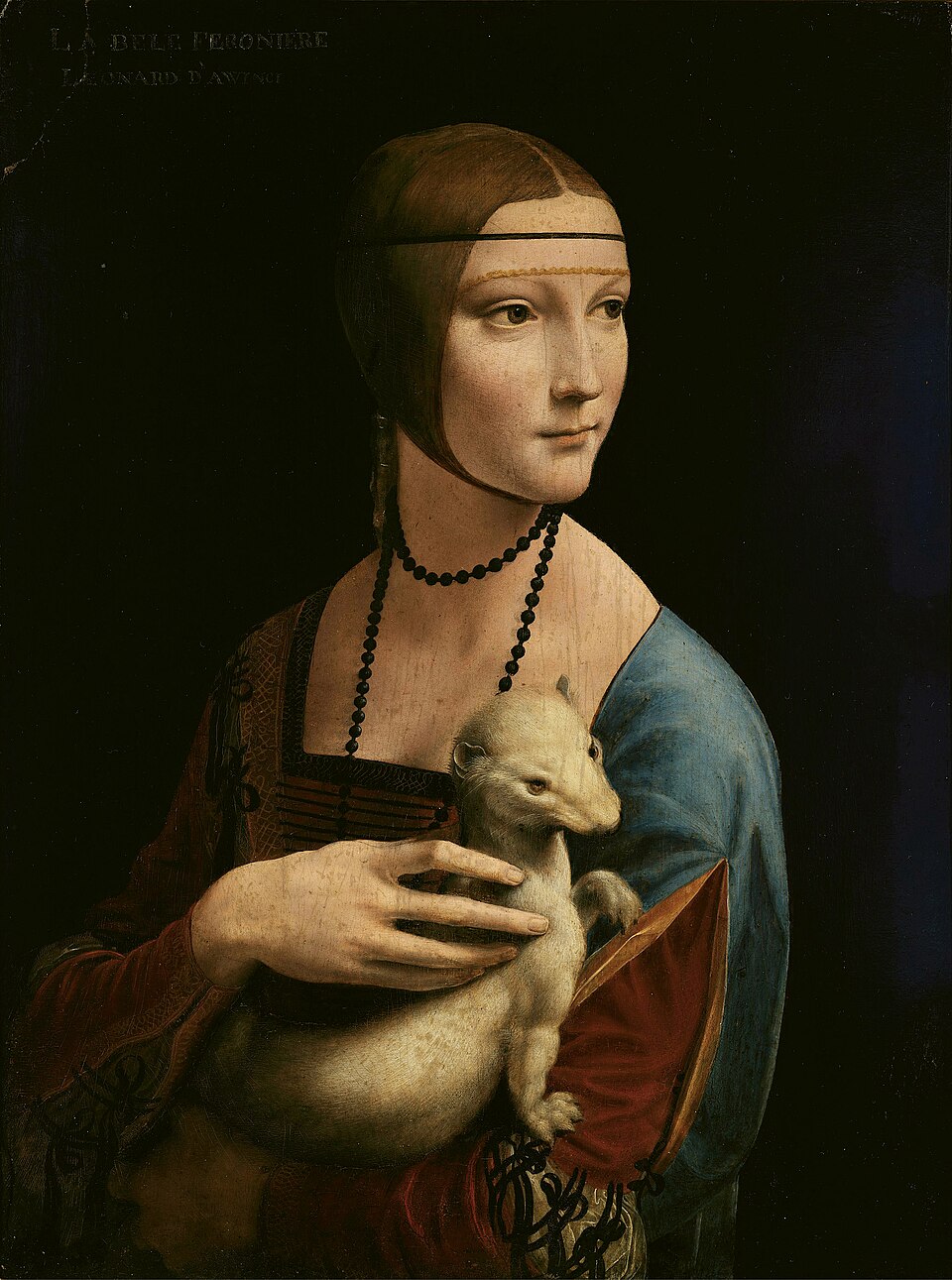
Unveiling the Masterpiece: Leonardo's Lady with an Ermine and its Enduring Mystery
Leonardo da Vinci, a name synonymous with unparalleled genius, left an indelible mark on the canvas of human history. While his monumental fresco, The Last Supper, captivates millions with its dramatic narrative, another of his masterpieces, the Lady with an Ermine, offers a profoundly intimate glimpse into the Renaissance soul. This exquisite oil painting on walnut wood panel, created between 1489 and 1491, stands as a testament to da Vinci's revolutionary approach to portraiture and his profound understanding of both human and animal anatomy. Often overshadowed by his more famous works, this painting holds a unique place, radiating an elegance and complexity that continues to fascinate art historians and enthusiasts alike.
The Milanese Muse: Cecilia Gallerani and Her Symbolic Companion
The captivating young woman at the heart of the Lady with an Ermine is widely identified as Cecilia Gallerani, a cultured and intelligent teenager who became the mistress of Ludovico Sforza, the Duke of Milan. It was during his tenure in Milan, serving the Duke, that Leonardo da Vinci brought this stunning portrait to life. Cecilia, celebrated for her beauty and intellect, was a significant figure in the Milanese court, making her an ideal subject for Leonardo's discerning eye.
The ermine she cradles so affectionately is far more than a mere pet; it is a creature laden with multifaceted symbolism, expertly woven into the fabric of the portrait by Leonardo. Historically, the ermine, a type of weasel, was a highly valued animal, admired for its pristine white winter coat. Legend held that the ermine was so fastidious, so devoted to purity, that it would rather die than soil its fur. This ancient belief subtly suggests Cecilia's own perceived wholesome and virtuous nature, even within the context of her position as the Duke's mistress.
However, the symbolism delves deeper, directly referencing Cecilia's powerful patron. Duke Ludovico Sforza himself bore a significant nickname: "Italico Morel bianco ermellino," or "Italian Moor, white ermine." By depicting Cecilia with this specific creature, Leonardo not only celebrated her personal grace but also subtly immortalized the romantic and powerful connection between the young woman and the Duke. It's a masterful stroke of symbolism, transforming a simple animal into a rich narrative device, celebrating both the girl's captivating beauty and the influential relationship that defined a chapter of her life.
Leonardo's Innovations: Beyond Traditional Portraiture
The Lady with an Ermine stands out amongst Renaissance portraits precisely because it defies the conventional poses of the era. Rather than the static, often profile, depictions common at the time, Leonardo chose to capture Cecilia in a moment of dynamic engagement. She is shown mid-movement, her head turned, seemingly responding to something outside the frame, while her gaze is intently fixed upon the ermine she holds. This unconventional and lively posture, a revolutionary concept for its time, lends an incredible sense of immediacy and life to the painting. It suggests a fleeting moment, a captured interaction rather than a rigid presentation, showcasing da Vinci's unparalleled artistry in rendering both human subjects and animals with profound sensitivity.
Leonardo's scientific curiosity and his relentless pursuit of anatomical realism are palpable in every brushstroke. The intricate details of Cecilia's features, the delicate structure of her hand, and the lively, almost sentient quality of the ermine are rendered with astonishing precision. This commitment to observation and realism is a hallmark of his work, whether he was meticulously studying the human form for anatomical drawings or crafting the dramatic figures in The Last Supper. In the Lady with an Ermine, we witness his mastery in portraying texture, movement, and the psychological depth of his sitter, making it a powerful display of his skill in portraiture and his innovative use of symbolism.
Challenges and Discoveries: The Painting's Journey Through Time
Like many ancient masterpieces, the Lady with an Ermine has not remained untouched by the ravages of time and the interventions of past restorers. This exquisite work, measuring 54.8 cm high and 40.3 cm wide, has undergone significant alterations since its creation. Most notably, the original background, which x-ray analyses have revealed once contained a doorway, was completely over-painted and darkened, likely in the 17th century. This dramatic change fundamentally alters the original spatial context Leonardo envisioned for Cecilia.
Further retouches include the dress below the ermine and even the transparent veil worn by Cecilia, which was repainted to match her hair color. This latter alteration has the unintended effect of making her hair appear to reach down and underneath her chin. Even elements as subtle as the fingers of her right hand show signs of later intervention, with dark shadows added and the bottom two fingers appearing somewhat inferior to the others due after an unknown restorer's work. These changes, while sometimes detracting from Leonardo's original intent, also provide valuable insights into the painting's long history and the changing aesthetic sensibilities of different eras. They underscore the importance of ongoing conservation efforts and the delicate balance between preservation and historical interpretation.
Leonardo's Diverse Genius: From The Last Supper to The Lady with an Ermine
The enduring appeal of The Last Supper Lady With An Ermine as a combined keyword highlights Leonardo da Vinci's extraordinary versatility and his ability to transcend different artistic genres with equal brilliance. From the grand narrative of The Last Supper, a monumental fresco exploring human emotion and divine betrayal, to the intimate psychology of the Lady with an Ermine, a captivating portrait of a young woman and her symbolic companion, Leonardo's genius knew no bounds.
His "enormously curious" nature meant he was constantly experimenting, often moving on to new challenges once he felt he had mastered a particular formal problem. This constant exploration of technique, perspective, and human experience is what unites these seemingly disparate works. While The Last Supper exemplifies his narrative prowess and mastery of composition on a vast scale, the Lady with an Ermine showcases his ability to capture individual personality and weave intricate symbolism into a singular, compelling image.
These masterpieces, though different in scope and subject, share the common thread of Leonardo's revolutionary vision. His innovative use of sfumato, his deep understanding of light and shadow, and his ability to imbue his subjects with profound inner life are evident in both. They are testaments to an incomparable creative mind that pushed the boundaries of art, science, and human understanding, leaving behind a legacy that continues to inspire and challenge us today. To delve deeper into his other iconic works and their unique attributes, you might explore The Last Supper Lady With An Ermine - Article 1, and for more specific insights into these enduring treasures, consider reading The Last Supper Lady With An Ermine - Article 3.
Conclusion: A Timeless Testament to Artistic Brilliance
The Lady with an Ermine remains one of the most important works in the entire Western art canon. As one of only a handful of authentic panel paintings by Leonardo da Vinci that survive today, it is an object of immense rarity and historical significance. Its captivating image of exquisite elegance, combined with the layers of symbolism and Leonardo's innovative artistic techniques, reveals the artistic genius of his incomparable creative mind. It stands not only as a portrait of a specific woman but as a profound exploration of human connection, power, and the enduring beauty that only a true master can distill onto a canvas. Centuries after its creation, the Lady with an Ermine continues to mesmerize, inviting viewers into a world where art, history, and human ingenuity converge in a timeless display of brilliance.